Black beans and pinto beans are among the most popular beans around, especially in Mexican cuisine. But which bean is better? They’re both nutritious and delicious, though it ultimately might come down to your own personal taste preferences. Read on to learn more about black beans vs pinto beans and see how they stack up!
This post may contain affiliate links. Please see our disclaimer for details.

Table of Contents
About Black Beans
Black beans are a type of legume that is classified as one of the most common beans. They’re native to Mexico and are easy to spot by their appearance. They are also called ‘turtle beans’ or ‘black turtle beans.’
Color & Appearance
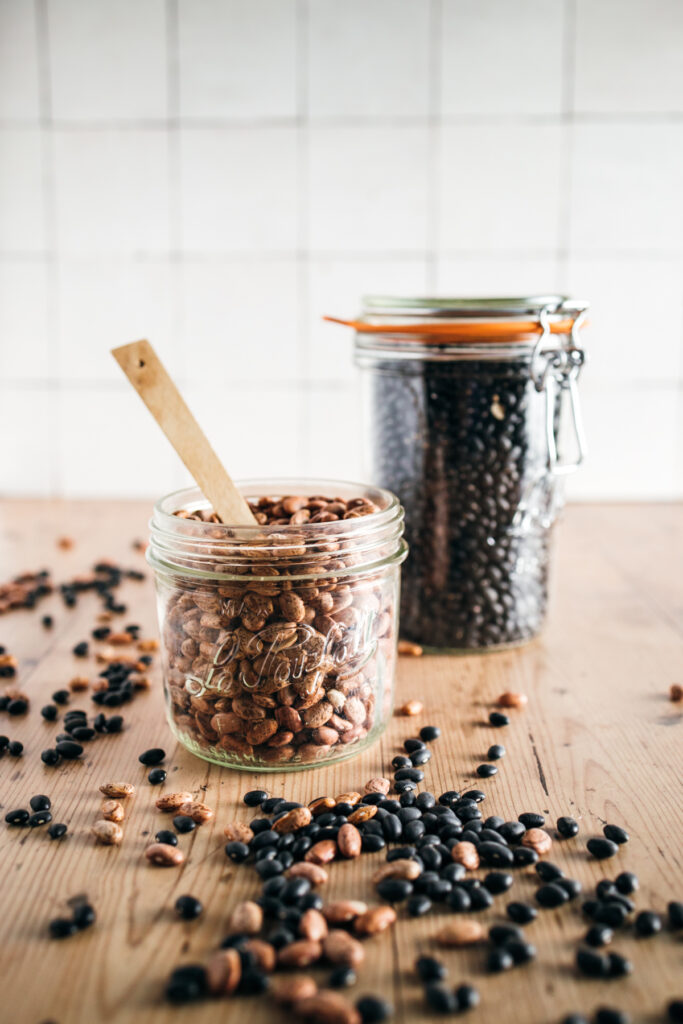
As the name suggests, black beans are matte black in color. They have an oval shape and on the interior, have a white color.
Taste & Texture
Deep and dense, black beans retain their shape even after cooking. Eating them straight from a can provides a firmer texture, though when cooked, they soften up. They’re very meaty and filling, making them an excellent option for hearty plant-based dishes such as stews or soups.
In case you’re wondering, here are my favorite dried black beans and canned black beans picks!
Culinary Uses
If you use the dried beans, you’ll want to soak them first and then cook them. For the canned beans, they can be used right away, either to cook with or to use in salads and other recipes.
Nutrition + Health Benefits
Black beans are nutritional powerhouses. Just a cup of black beans boasts 15 grams of protein, 41 grams of carbohydrates, 15 grams of fiber, and 1 gram of fat. Black beans are an excellent source of folate, copper, thiamine, manganese, magnesium, and iron. In addition, they are a good source of phosphorus and potassium. Black beans are also a great source of antioxidants, particularly anthocyanins, that help combat oxidative processes in the body [1].
Black beans have been found to stabilize blood sugar [2]. They also play a role in lowering blood pressure, reducing cholesterol levels, and decreasing the risk of heart disease [1]. Black bean’s high fiber composition may also benefit those with depression [3].
About Pinto Beans
Pinto beans are a type of mottled bean, which you can notice if you buy them dried. If you buy them canned, they will appear almost pinkish in hue. They come from Mexico and Peru, where they have been enjoyed for centuries.
Color & Appearance
When you look at a bag of pinto beans, they will all have unique patterns. Cooking them gives them a uniform color and appearance.
Taste & Texture
The creamy texture of pinto beans, along with their mild flavor, makes them a delight in recipes. They can be soaked and cooked quickly, though turning them out from a can works well in a pinch. It’s important to be mindful when cooking pinto beans because they can become mushy when cooked too long.
By the way, these are my favorite dried pinto beans and canned pinto beans to pick!
Culinary Uses
If you love Mexican cuisine, you probably adore refried beans, which are made from pinto beans. They can also be used in chili, soups, stews, burritos, salads, and much more.
Nutrition + Health Benefits
Pinto beans are packed with healthy plant-based nutrition. One cup of cooked pinto beans contains a total of 245 calories. (15 grams of protein, 45 grams of carbohydrates, 15 grams of dietary fiber, and 1 gram of fat.) Pinto beans are an excellent source of thiamine, iron, magnesium, copper, potassium, phosphorus, and vitamin B6. In addition, they are also a good source of niacin, choline, and vitamin C. Pinto beans are also high in antioxidants, specifically the flavonoid kaempferol.
Would you like to save this?
Regular consumption of pinto beans can improve blood sugar control [4]. They have been shown to lower blood pressure, total cholesterol, and LCL cholesterol [5, 6].
Pinto beans are high in fiber. Fiber has been directly associated with improved mental health, specifically psychological distress and anxiety. In addition, fiber has been found to reduce the likelihood of depression in women [3].

Comparing the Two
Black beans vs pinto beans differ in color and texture. Both are incredibly nutritious and provide health benefits, and while they can fill in for one another, they’re not an exact swap. Additionally, black beans do have just a little more fiber, but if you’re eating beans anyway, the amount is probably not as significant. Ultimately, you may prefer to eat one over the other, and that’s perfectly fine since they’re both healthy options for your plant-based meals.
Nutritional Comparison
If you’re wondering how black beans and pinto beans compare nutritionally, this chart is for you. The nutrition information below is from the USDA FoodData Central Database. The values below are for one cup of mature seeds, cooked, boiled, and without salt.
| Nutrients | Black Beans | Pinto Beans |
|---|---|---|
| Calories | 227 | 245 |
| Fat | 1 g | 1 g |
| Carbs | 41 g | 45 g |
| Fiber | 15 g | 15 g |
| Protein | 15 g | 15 g |
| Calcium | 46 mg | 79 mg |
| Iron | 3.6 mg | 3.6 mg |
| Magnesium | 120 mg | 86 mg |
| Phosphorus | 241 mg | 251 mg |
| Potassium | 611 mg | 746 mg |
| Sodium | 2 mg | 2 mg |
| Zinc | 1.93 mg | 1.68 mg |
| Copper | 0.359 mg | 0.374 mg |
| Manganese | 0.76 mg | 0.78 mg |
| Selenium | 2 µg | 11 µg |
| Folate | 256 µg | 294 µg |
| Choline | 56 mg | 60 mg |
| Vitamin A | 10 IU | 0 IU |
| Vitamin C | 0 mg | 1.4 mg |
| Vitamin D | 0 IU | 0 IU |
| Vitamin E | 1.5 mg | 1.6 mg |
| Vitamin K | 5.68 µg | 5.98 µg |
| Thiamin | 0.42 mg | 0.33 mg |
| Riboflavin | 0.101 mg | 0.106 mg |
| Niacin | 0.869 mg | 0.544 mg |
| Pantothenic acid | 0.416 mg | 0.359 mg |
| Vitamin B6 | 0.119 mg | 0.392 mg |
| Vitamin B 12 | 0 µg | 0 µg |
Cooking With Beans
If you’re ready to enjoy these beans, here are some recipes to start with!
If you are completely new to cooking with beans, I suggest my plant-based cooking how-to’s, such as this Instant Pot Black Beans recipe.
Try out this fan-favorite Black Bean Veggie Burger. Maybe you’d like some filling plant-based soup instead? Make this Homemade Vegan Chili, Pumpkin Chili, Vegan Black Bean Soup, Classic Minestrone, or the Best Vegetable Soup Ever.


If you read this Black Beans vs. Pinto Beans post or any other one on my blog, please let me know how it went in the 📝 comments below. Thanks for visiting!
Final Words
There are many differences between black beans and pinto beans, particularly in their appearance. They can both be used with ease in just about any dish where you’d add beans, especially Mexican cuisine, though don’t let that limit you. You can soak and cook either kind and use them, or open up a can to get a fiber-rich and nutritious meal that tastes amazing!
References
[1] Chávez-Mendoza, C., & Sánchez, E. (2017). Bioactive Compounds from Mexican Varieties of the Common Bean (Phaseolus vulgaris): Implications for Health. Molecules (Basel, Switzerland), 22(8), 1360. https://doi.org/10.3390/molecules22081360
[2] Reverri, E. J., Randolph, J. M., Steinberg, F. M., Kappagoda, C. T., Edirisinghe, I., & Burton-Freeman, B. M. (2015). Black Beans, Fiber, and Antioxidant Capacity Pilot Study: Examination of Whole Foods vs. Functional Components on Postprandial Metabolic, Oxidative Stress, and Inflammation in Adults with Metabolic Syndrome. Nutrients, 7(8), 6139–6154. https://doi.org/10.3390/nu7085273
[3] Saghafian, F., Sharif, N., Saneei, P., Keshteli, A. H., Hosseinzadeh-Attar, M. J., Afshar, H., Esmaillzadeh, A., & Adibi, P. (2021). Consumption of Dietary Fiber in Relation to Psychological Disorders in Adults. Frontiers in psychiatry, 12, 587468. https://doi.org/10.3389/fpsyt.2021.587468
[4] Thompson, S. V., Winham, D. M., & Hutchins, A. M. (2012). Bean and rice meals reduce postprandial glycemic response in adults with type 2 diabetes: a cross-over study. Nutrition journal, 11, 23. https://doi.org/10.1186/1475-2891-11-23
[5] Pluznick J. (2014). A novel SCFA receptor, the microbiota, and blood pressure regulation. Gut microbes, 5(2), 202–207. https://pubmed.ncbi.nlm.nih.gov/24429443/
[6] Nelson R. H. (2013). Hyperlipidemia as a risk factor for cardiovascular disease. Primary care, 40(1), 195–211. https://doi.org/10.1016/j.pop.2012.11.003